
Our Stories
Stories of the families we partner with and their accomplishments are at the heart of our mission and the best way to illustrate our work. We hope these stories of just a handful of our families building resilience will inspire you.
- Kinship Family – “Kinship families need the support and resources that Navigators are able to provide.” Read more
- PCAP Mother – “I just want to tell you how lucky and happy I am to have you in my life.” Read More
Teya Harris’ Story
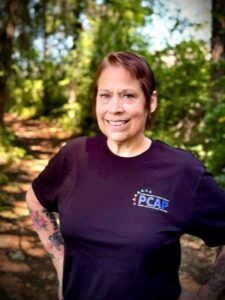 “Drug court saved my life,” says Teya Harris. She was 46 years old when she landed in drug court, after using drugs/alcohol since about the age of 9. “Drug court was the first time I got trauma informed therapy,” she says. (Participants in drug court can avoid prison time if, like Teya, they succeed in outpatient treatment and abide by other legal requirements of the program.)
The therapy helped Teya turn her abundant empathy and compassion inward. For much of her life – both before and since drug court – empathy and compassion for others have been a big part of who she is.
In the years before drug court, Teya had used drugs/alcohol for many reasons: to stay awake; to function socially; to cope with domestic violence, to mask severe inter-generational trauma and to hold a job – something she always did. “I was what they call a ‘high functioning addict;’ I was able to hold a full-time job, go to school, and be a single parent.”
She was successful in restaurant management. In that role, she mentored many troubled teens, taught them how to work, and helped them recover from their own traumatic experiences and become adults.
As she was growing up, she had experienced both severe, ongoing family trauma and useful training in life skills from one of the adults in her life. That strange combination contributed to both her deep well of compassion for the suffering, and a generous measure of grit and self-discipline.
That self-discipline helped her succeed academically as well as in the restaurant business. She earned a GED, a two-year Associate degree, and a BA degree in business management. But while she exceled at work and was a godsend to neglected teens, the relationships she lived with involved domestic abuse, and her addiction was fierce.
Her final drug-related domestic relationship, which lasted six months, was with a guy who robbed houses – often two or three a day. That kept them generously supplied with drugs. But it ended with both of them arrested, and both charged with multiple felonies. Because she had no prior arrests – not even a speeding ticket – she was eligible for Thurston County drug court program.
The therapy and support provided by drug court launched her long-term sobriety and the flowering of a satisfying, functional and productive life, complete with healthy, loving family relationships. In her 35 years of addiction, she had never been clean for more than six months.
She has deep regrets. “I can’t ever give back the keepsakes and personal treasures that were stolen, but this job means I can give back to the community. Working here at FESS in the PCAP Program, I can let women know that somebody loves them and cares for them.”
“FESS hired me right out the drug court program with two years of clean time from drugs/alcohol. I had never done case management before, but the director of the drug court program and the prosecuting attorney from my legal case set me up to interview for the Parent Child Assistance Program (PCAP). They said that I have been doing this work my whole life. FESS took a chance on me and nine years later I am the woman, friend, community member, employee, and kinship caregiver of two young children that I am today.”
PCAP was just six months old when Teya was hired. Its aim is to intervene early with pregnant and parenting women who have substance abuse disorders. The idea came from a researcher who, in the 1990s, was studying the effect of prenatal exposure to drugs and alcohol on babies. She noticed that many of the mothers she interviewed came from dysfunctional families where addiction and abuse were a way of life. And many of them had more than one baby that was exposed to drugs and/or alcohol in the womb. She was inspired to research ways to break that cycle by tending to the needs of the pregnant women and mothers.
The initial goal of the effort was to reduce the number of drug-exposed babies. But of course the way to do this was to dramatically improve the quality of life of the mothers – not just by getting them to take a course of drug treatment, but to change the trajectory of their lives.
That research led to the creation of PCAP. It provides each pregnant or parenting mom with a three-year partnership with a case manager/personal advocate who specializes in working to connect her with basic needs like housing, income, clothing, baby supplies, therapy, education, and peer support. No need is too large or too small; sometimes it’s a matter of removing obstacles to success. These highly educated case manager/advocates don’t let clients drift away. They track them down, visit them wherever they find them, and provide what they call “universal positive regard” for their value and their prospects for a better future.
They also help women become self-sufficient, independent thinkers and planners who control their own lives.
This once-experimental program has now become a proven “best practice” that is spreading across the country. It significantly reduces the number of second or third drug and alcohol affected infants – and that is the tip of a sturdy tower of positive benefits.
Some of those benefits come long after the three-year program has ended, and may never be among the PCAP statistics. In her nine years working at FESS, Teya doesn’t count successes and failures; her focus is on planting seeds, and providing resources. She has faith that clients will succeed when those seeds sprout. “Just the other day I had an email from a woman I had met only briefly five or six years ago. I was amazed she even had my email after all this time. But she asked for resources, and I was able to provide them. That’s a seed that’s just now sprouting.”